
How Long Should a Refrigerator Last Oshawa is common questions people ask? A refrigerator should last between 10 and 15 years on average. Depending on the type, brand, and how consistently it is maintained, some units push past 20 years while others struggle to reach a decade. For Oshawa homeowners weighing the cost of repairs versus a full replacement, understanding the typical lifespan of your specific fridge model is the smartest starting point.
Problems with Broken Appliances in Oshawa Residences?
Dealing with damaged or malfunctioning appliances in your Oshawa residence can disrupt your daily routine. From refrigerators and washers to ovens and dryers, quick attention to broken appliances helps restore comfort, convenience, and normal household operations.
Why Refrigerator Lifespan Matters More Than You Think
Your refrigerator runs every single day, 24 hours a day, 365 days a year. It is one of the only appliances in your home that never gets a break. Most homeowners in Oshawa and across Durham Region give it little thought until something goes wrong and suddenly they are staring at a warm unit full of spoiled groceries.
Knowing how long a fridge typically lasts helps you budget smarter, recognize early warning signs before a complete breakdown, and avoid throwing money at repairs on a unit that is already past its prime. It also helps you make a confident decision between calling a technician and simply replacing the appliance altogether.
The Average Lifespan of a Refrigerator
The U.S. Department of Energy reports the average refrigerator lasts approximately 12 years, though real world performance ranges from 10 to 20 years depending on several variables. Most appliance repair professionals and consumer research organizations point to 13 to 15 years as the realistic target for a well maintained unit.
That range is not a guarantee. A budget model kept in a hot garage and consistently overpacked might give up at 8 years. A premium built-in unit cleaned regularly and set to the proper temperature could still be running strong at 20.
The takeaway for Oshawa homeowners is straightforward: if your fridge is under 10 years old and breaks down, repair is usually worth it. If it is pushing 15 years or more, replacement often makes more financial sense than investing in ongoing repairs.
Refrigerator Lifespan by Type
Not all refrigerators age the same way. The style and configuration of your unit plays a significant role in how many years you can realistically expect from it.
Top Freezer Refrigerators These are the workhorses of the appliance world. Their simpler mechanical design, with fewer components and no elaborate ice or water dispensing systems, means less can go wrong. Top freezer units typically last 15 to 20 years and are widely considered the most reliable style for long term use.
Bottom Freezer Refrigerators Bottom freezer models offer more convenient access to fresh food at eye level and tend to last between 13 and 17 years. They have more moving parts than top freezer units but are generally more reliable than side by side or French door configurations.
Side by Side Refrigerators Side by side units often include built in water dispensers and ice makers, which add valves, switches, motors, and water lines that can fail over time. Most side by side fridges last between 8 and 14 years, with the ice and water systems being among the most common sources of service calls.
French Door Refrigerators French door models have become popular in Oshawa homes for their aesthetic appeal and storage flexibility. They typically last 10 to 15 years, though the added complexity of dual evaporators and built in features can reduce that range if maintenance is neglected.
Built-In Refrigerators High end built-in units are designed for longevity. With premium materials, stronger compressors, and superior insulation, built-in refrigerators regularly reach 20 to 25 years of service life.
Key Factors That Affect How Long Your Fridge Lasts
Several variables directly influence the service life of your refrigerator. Understanding them helps you take practical steps to extend the life of your current unit.
Temperature Settings Running your refrigerator at the correct temperature reduces unnecessary strain on the compressor. The recommended range for the fresh food compartment is between 1 and 3 degrees Celsius (35 to 38 degrees Fahrenheit), while the freezer should sit at around minus 18 degrees Celsius (0 degrees Fahrenheit). Settings outside these ranges force the compressor to work harder than it needs to.
Door Seal Integrity The rubber gaskets around your refrigerator and freezer doors are responsible for keeping cold air inside. A cracked or worn door seal allows cold air to escape continuously, causing the unit to run longer cooling cycles and accelerating wear on the compressor and evaporator. Checking your seals regularly and replacing them when they show signs of deterioration is one of the simplest maintenance tasks you can do.
Condenser Coil Condition The condenser coils, typically located at the back or beneath your refrigerator, dissipate heat as part of the cooling cycle. When these coils become clogged with dust, pet hair, and debris, the unit struggles to release heat efficiently and the motor is forced to compensate. Cleaning condenser coils every six months is a widely recommended maintenance practice that directly extends fridge lifespan.
Location and Ambient Temperature A refrigerator placed in a garage, near a heat vent, or directly beside an oven is working against itself from the start. The higher the ambient temperature around the unit, the harder the compressor must work to maintain internal cooling. In Ontario, where garages can experience extreme temperature swings between summer and winter, placing a secondary fridge in an uninsulated space can shorten its lifespan considerably.
How Full You Keep It A refrigerator that is consistently overpacked has restricted airflow inside the cabinet, which forces the cooling system to work harder to maintain even temperatures. On the other hand, a nearly empty fridge also runs less efficiently because it lacks the thermal mass to help stabilize internal temperature when the door is opened. Keeping the unit reasonably stocked, without blocking vents, is the sweet spot.
How Often the Door Is Opened Each time the refrigerator door opens, warm air rushes in and the cooling system must compensate. In a busy household with multiple family members opening the fridge frequently, this adds up over years. Teaching family members to know what they want before opening the door is a small habit that contributes to long term efficiency.
Signs Your Refrigerator Is Nearing the End of Its Life
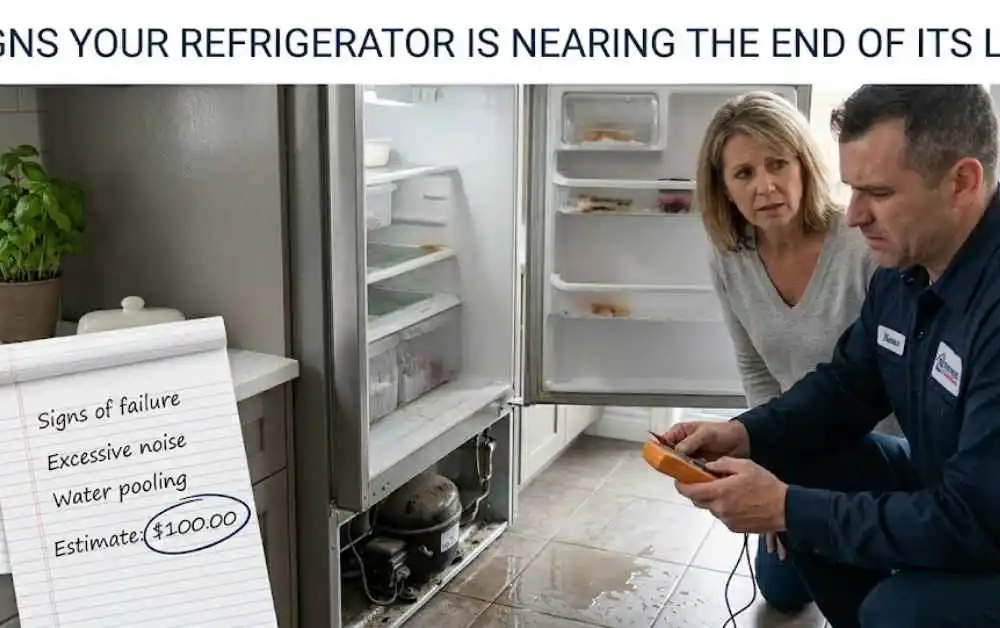
Refrigerators rarely quit without warning. Before a complete failure, most units show a pattern of symptoms that indicate serious wear. Oshawa homeowners who recognize these signs early can plan for replacement before a breakdown leaves them scrambling.
Inconsistent or Insufficient Cooling If you notice that food is spoiling faster than usual, condensation is forming where it should not, or sections of the fridge feel warmer than others, the cooling system is struggling. This can point to a failing compressor, refrigerant leak, or damaged evaporator fan.
The Compressor Runs Constantly A healthy refrigerator cycles on and off throughout the day. If your unit seems to run non stop without ever cycling down, it is working much harder than it should. This accelerates wear across every major component and shows up as higher electricity bills.
Unusual Noises Some hum and occasional clicking from your refrigerator is completely normal. Loud banging, rattling, or high pitched whining sounds coming from the back or bottom of the unit often indicate problems with the compressor, condenser fan, or evaporator fan motor.
Excess Condensation or Frost Buildup Condensation forming on the exterior of the unit, or heavy frost accumulating in the freezer, signals that the defrost system or door seals are failing. Left unaddressed, these issues progressively worsen and can lead to full unit failure.
Rising Energy Bills An older refrigerator that is struggling mechanically often becomes an energy hog. If your hydro bill in Oshawa has crept upward without a clear explanation, your fridge could be drawing significantly more power than it should. A newer Energy Star certified model can reduce refrigerator related energy consumption by 40 to 60 percent compared to a 15 to 20 year old unit.
Frequent or Recurring Repairs One repair in the lifespan of a fridge is normal. Multiple repairs within a short period, especially on a unit over 10 years old, is a clear signal that the appliance is in a general state of decline. Each fix that keeps an old fridge running is usually a temporary solution to a broader reliability problem.
The 50 Percent Rule: Repair or Replace?
The most widely used guideline in appliance repair is sometimes called the 50 percent rule. If the cost of repairing your refrigerator exceeds 50 percent of the price of a comparable new unit, replacement is typically the smarter financial decision.
For example, if a new refrigerator equivalent to yours costs $1,400 and you receive a repair quote of $600, that represents roughly 43 percent of replacement cost. Repairing it is probably reasonable if the unit is not too old. But if the repair quote is $800 or more, the calculus changes.
Age complicates this rule further. Many appliance repair professionals suggest lowering the threshold to 30 percent for units that are already 10 years old or more. A $400 repair on a 12 year old fridge may be reasonable math on paper, but you are investing in a unit that statistically has limited years remaining and is likely becoming less energy efficient with each passing season.
Average refrigerator repair costs in Ontario typically range from $200 to $500 depending on the component involved. Compressor replacement sits at the high end and often makes replacement the more sensible choice, particularly on older units.
Most Reliable Refrigerator Brands for Canadian Homeowners
Brand choice matters when it comes to longevity. Consumer research consistently highlights a meaningful difference in reliability between brands.
Whirlpool, LG, and Bosch consistently rank among the more reliable brands across various refrigerator styles. Sub Zero and Miele occupy the premium end of the market and are known for exceptional longevity, often exceeding 20 years of service. Frigidaire and GE offer solid mid range reliability at more accessible price points.
Samsung has received mixed reliability reviews in recent years, particularly around ice maker issues in French door models. According to Consumer Reports survey data, nearly half of all refrigerators purchased since 2015 have experienced at least one problem, with ice maker failures being among the most commonly reported issues across brands.
For Oshawa homeowners looking to balance cost and longevity, mid range models from Whirlpool, LG, or Frigidaire in a top freezer or bottom freezer configuration tend to represent the best long term value.
How to Extend the Life of Your Refrigerator

Proper maintenance is the single most effective way to get the most years out of your fridge. These practical steps require minimal time and cost, but they make a real difference over a decade of daily use.
Clean the condenser coils every six months by vacuuming the coils at the back or beneath the unit. If you have pets, increase this to every three to four months as pet hair accelerates buildup significantly.
Inspect the door gaskets every few months by running your hand along the seal while the door is closed to feel for any cold air escaping. Replace gaskets at the first sign of cracking, stiffening, or poor adhesion.
Set the correct temperature using a refrigerator thermometer rather than relying on the built-in dial. Factory settings are not always accurate, and a few degrees off in either direction can affect both food safety and compressor wear.
Keep the area around and behind the unit clear so that heat can dissipate freely from the condenser coils. At minimum, leave a few inches of clearance at the back and sides.
Avoid placing the unit near heat sources such as ovens, dishwashers, direct sunlight from a window, or in an uninsulated garage space if you are in the Oshawa area and want to avoid the extreme temperature fluctuations that come with Ontario winters and summers.
Defrost a manual defrost freezer before frost buildup exceeds about a centimetre in depth. On frost free models, pay attention to unusually heavy frost accumulation as this indicates a defrost system issue that should be addressed promptly.
When to Call a Technician Versus When to Replace
Knowing the age and service history of your refrigerator helps frame this decision clearly. Here is a straightforward way to think about it.
If your fridge is under 8 years old and encountering its first significant problem, call a qualified appliance technician for an assessment before deciding anything. Most issues at this age are worth repairing if the cost is below the 50 percent threshold.
If your fridge is between 8 and 12 years old and showing problems, apply the adjusted 30 to 50 percent rule based on how well the unit has performed historically. A unit with no prior service history in good physical condition is worth repairing at a reasonable cost. One with a pattern of problems is probably not.
If your fridge is 12 to 15 years old or beyond, lean toward replacement unless the repair is minor and inexpensive. You are approaching or past the average service life of most units, energy efficiency has declined considerably, and repair costs at this stage rarely deliver proportionate value.
Oshawa residents can contact licensed appliance repair technicians through Durham Region service directories. Getting a written diagnostic quote before committing to any repair is always advisable.
Refrigerator Disposal and Replacement in Oshawa

When it is time to retire your old fridge, Oshawa homeowners have a few environmentally responsible options. The Region of Durham operates an appliance pickup program for large household items. Many appliance retailers also offer haul away services when they deliver a new unit.
Some older refrigerators, particularly those manufactured before 2000, may contain refrigerants such as R-22 that require certified handling during disposal. A licensed appliance technician or authorized waste facility can manage this safely and in compliance with provincial environmental regulations.
Energy Star certified refrigerators purchased as replacements may qualify for rebates through local utility programs or provincial initiatives. Checking with Oshawa Power or the Ontario government rebate programs at the time of purchase is worth the few minutes it takes.
👉🏻Discover More About Unique Appliance Problem[ Signs Your Refrigerator Door Seal Needs Replacing ]
Frequently Asked Questions
How long does a refrigerator last on average?
Most refrigerators last between 10 and 15 years under normal use and maintenance. The U.S. Department of Energy cites approximately 12 years as the average, though top freezer models with simple designs can regularly reach 18 to 20 years.
Is it worth repairing a refrigerator that is 10 years old?
It depends on the cost of the repair and the overall condition of the unit. Apply the 30 percent rule for units over 10 years old: if the repair exceeds 30 percent of the cost of a comparable new refrigerator, replacement is usually the better long term investment.
What is the most reliable type of refrigerator?
Top freezer refrigerators are consistently rated as the most reliable style due to their simpler mechanical design and fewer components that can fail. They also tend to be the most energy efficient configuration available.
What causes a refrigerator to fail early?
The most common causes of premature refrigerator failure include dirty condenser coils, failed door gaskets, improper temperature settings, placement in high heat environments such as garages, and overloading the unit which restricts airflow and strains the compressor.
How can I tell if my refrigerator compressor is failing?
Signs of a failing compressor include the unit running constantly without cycling off, rising internal temperatures despite normal settings, unusually loud motor noise from the back of the unit, and a noticeable increase in electricity consumption. A compressor replacement on an older fridge often makes replacement more economical.
How often should I clean my refrigerator coils?
Every six months is the standard recommendation for most households. If you have pets, every three to four months is advisable since pet hair accelerates coil buildup and reduces cooling efficiency significantly.
Does where I put my refrigerator affect how long it lasts?
Yes, significantly. Placing a refrigerator in a hot environment such as near an oven, in direct sunlight, or in an unheated garage forces the compressor to work harder and shortens the unit’s service life. In Ontario’s climate, a garage fridge experiences wide seasonal temperature swings that are particularly hard on the cooling system.
What should I do with my old refrigerator in Oshawa?
Durham Region offers large appliance pickup through their waste management program. Many appliance retailers will also haul away your old unit when delivering a replacement. For older fridges containing regulated refrigerants, ensure disposal is handled by a licensed technician.
Conclusion
A refrigerator is one of the hardest working appliances in any Oshawa home, and understanding its expected lifespan puts you in a much stronger position when problems arise. Most units will serve you faithfully for 10 to 15 years with basic care, and top freezer models kept in good condition can push well beyond that range.
The difference between a fridge that quits at 8 years and one that runs to 18 often comes down to a few straightforward habits: keeping the coils clean, checking the door seals, setting the correct temperature, and giving the unit room to breathe. When repairs do become necessary, applying the 50 percent rule and factoring in your unit’s age and service history will steer you toward the right decision every time.