
Hard water in Durham Region, Ontario, contains elevated levels of dissolved calcium and magnesium minerals. When this water flows through your washing machine repeatedly, those minerals deposit themselves onto the drum’s interior surface, the rubber door gasket, the heating element, and the inlet valves. Over months and years, this mineral buildup, commonly called limescale or scale, corrodes metal surfaces, degrades rubber seals, restricts water flow, forces the motor to work harder, and ultimately shortens the lifespan of the entire appliance. Homeowners in cities like Oshawa, Whitby, Ajax, and Pickering are especially vulnerable because the regional water supply drawn from Lake Ontario and local groundwater consistently registers in the hard to very hard range.
What Homeowners Experience During Appliance Breakdowns in Oshawa
When appliances suddenly stop working, homeowners in Oshawa often face disruptions to their daily routines, from spoiled food caused by a faulty refrigerator to laundry delays from a broken washer or dryer. Fast and reliable repairs can help prevent further inconvenience and costly damage. Whether you need refrigerator repair, washing machine repair, dryer repair, dishwasher repair, oven repair, or stove repair, professional technicians can quickly diagnose the issue and restore your household appliances to proper working condition.
Understanding Water Hardness in Durham Region, Ontario
Before you can understand what hard water does to your washing machine, it helps to understand what you are actually dealing with in Durham Region.
The Regional Municipality of Durham draws its drinking water primarily from Lake Ontario, with the Oshawa Drinking Water System serving communities including Oshawa, Whitby, Ajax, Pickering, Brooklin, and portions of Clarington. Lake Ontario water passes through limestone-rich bedrock and calcium-dense geological formations before it ever reaches a treatment plant. By the time treated water arrives at your home through the municipal distribution system, it still carries a measurable mineral load.
Across Ontario, water hardness is measured in milligrams per litre of calcium carbonate (mg/L) or in grains per gallon (gpg). Water above 120 mg/L is classified as hard, and water above 180 mg/L is considered very hard. Durham Region municipalities regularly report hardness levels in the range that causes genuine concern for household appliances. In practical terms, every litre of water running through your washing machine is depositing tiny amounts of calcium and magnesium onto every surface it touches. Run a wash cycle once a day, and you have 365 deposits per year quietly building up inside your machine.
What Actually Happens Inside Your Washing Machine Drum
Most people think of a washing machine drum as just a big metal barrel that spins. In reality, the drum works alongside an interconnected system of heating elements, inlet valves, rubber seals, pumps, and hoses. Hard water does not just affect one part. It goes after all of them simultaneously.
When hard water enters your washing machine, it heats up during a warm or hot wash cycle. Heat causes the dissolved minerals to crystallize and fall out of suspension. The moment those minerals have nowhere to go, they adhere to whatever surface is nearest, which includes the inner stainless steel drum, the rubber door gasket on front-load machines, the water inlet valve screens, and the heating element coil. This process is identical to what happens when you boil a kettle repeatedly without descaling it. The machine has no way to flush those deposits out on its own.
The stainless steel drum itself can handle minor mineral deposits for a while. But as the layer thickens, it changes the surface texture of the drum. What was once smooth stainless steel becomes rough and chalky. That rough surface can snag delicate fabrics, cause clothing to feel scratchy after washing, and in advanced cases, leave white or gray film on dark garments. If you have been noticing white residue on your clothes after washing them in Oshawa or Pickering, your water mineral content is almost certainly responsible.
The Progressive Stages of Hard Water Damage to Washing Machine Drums
Hard water damage does not happen overnight. It follows a slow, predictable progression that many homeowners do not notice until the machine is already significantly compromised.
Stage One: Early Mineral Film (Months 1 to 12)
In the first year, especially with a new machine, the signs are subtle. You might notice your clothes feel slightly less soft than expected. Towels in particular lose their fluffy texture because mineral residue is bonding to the fabric fibres along with the drum surface. Inside the machine, a faint chalky film begins forming around the drum’s drainage holes and at the base of the drum where water pools before the spin cycle removes it. This stage is completely reversible with regular maintenance.
Stage Two: Scale Layer Formation (Year 1 to Year 3)
Between the first and third year of use in a hard water area, the mineral film solidifies into actual scale. This chalky crust builds up around the drum’s perforations, along the back wall of the drum, and increasingly on the door seal. On front-load washers, the rubber gasket develops visible white deposits in its folds. That gasket is now at risk because mineral-encrusted rubber cannot flex normally. Micro-tears begin forming in the seal, which is how hard water eventually causes a front-loader to develop leaks. Repair shops across Durham Region see this pattern regularly, and a door gasket replacement typically runs between $100 and $200 in this area once the damage has already progressed.
Stage Three: Component Corrosion and Mechanical Failure (Year 3 and Beyond)
By year three or four, if descaling treatments have been neglected, the scale layer has become thick enough to interfere with mechanical function. The drum bearing, which allows the drum to spin smoothly, is now dealing with added friction from mineral deposits. Strange grinding or rumbling noises during the spin cycle are a common symptom at this stage. The drum may feel louder than it did when new. Meanwhile, the water inlet valve has accumulated enough scale on its screen and internal components that water fills the drum more slowly, sometimes triggering error codes on digital machines. The heating element, if your machine has one, is now coated in insulating mineral scale, which means it draws more electricity to reach the same temperature.
How the Drum Bearing Suffers Specifically
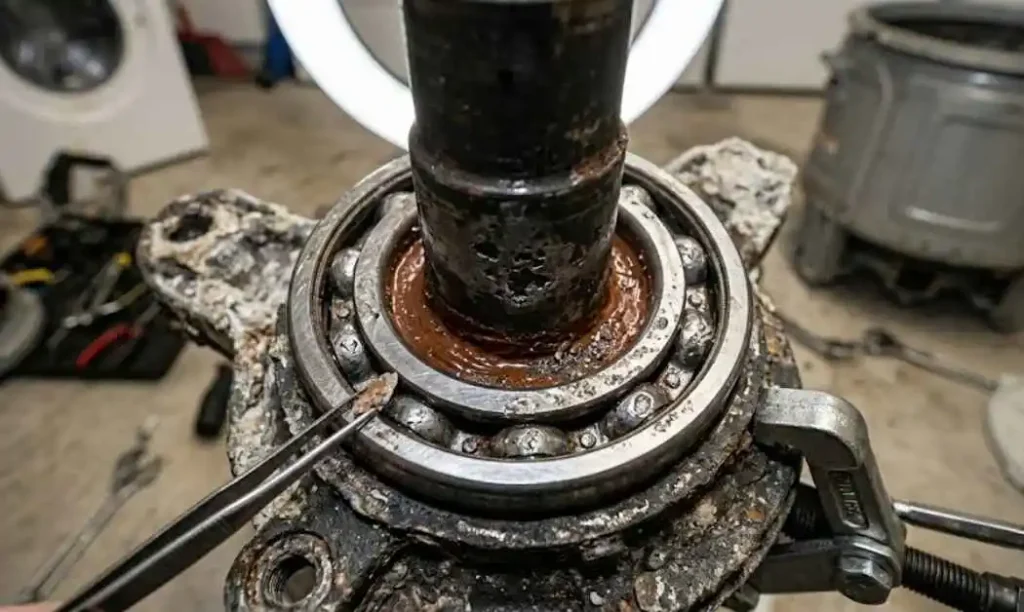
The drum bearing in a washing machine is what allows the inner drum to rotate independently of the outer drum. In a healthy machine, this bearing operates silently and lasts for years. Hard water accelerates bearing failure in two ways.
First, limescale that forms near the drum shaft and bearing housing can physically intrude on the bearing’s clearances. Second, and more commonly in Durham Region homes, mineral-laden water that migrates past the drum seal during wash cycles eventually contaminates the bearing lubricant. Once contaminated, the bearing degrades faster. By the time most homeowners in Whitby or Ajax notice that distinctive rhythmic thudding noise during the spin cycle, the drum bearing is already failing. Replacing a drum bearing typically costs anywhere from $200 to $400 in parts and labour in the Durham Region area, and it requires almost complete disassembly of the machine. In many cases, homeowners choose to replace the machine entirely rather than pay for a bearing job on an older unit.
The Role of Limescale on the Heating Element and Energy Consumption
Washing machines that use a heating element to warm water for warm and hot wash cycles face a specific hard water threat that goes beyond the drum itself but ultimately affects how hard the drum’s motor has to work.
When scale builds up on the heating element, it acts as a thermal insulator. The element has to stay on longer to push the same amount of heat through the mineral crust into the water. This means every warm wash cycle draws more electricity than it should. Over time, the element itself overheats within the scale coating and eventually fails. Once the heating element fails, your machine can no longer reach proper wash temperatures, which in turn means detergent does not dissolve or activate properly. Undissolved detergent residue then contributes its own layer of buildup inside the drum and on the drum’s interior surfaces, compounding the mineral scale problem.
For households in Clarington and Oshawa running two to three loads per week, the cumulative energy waste from scale-coated heating elements can add meaningfully to hydro bills over the course of a year.
Hard Water and Detergent: The Problem You Are Making Worse Without Realizing It
One of the most overlooked consequences of washing with hard water in Durham Region is what happens to your detergent before it ever gets to work on your clothes.
Calcium and magnesium ions in hard water react chemically with the active surfactants in laundry detergent. This reaction creates an insoluble soap scum rather than the cleaning lather the detergent was designed to produce. As a result, you need more detergent to get the same cleaning result. The instinct to pour a bigger scoop is natural, but it creates a secondary problem. Excess undissolved detergent accumulates inside the drum, in the detergent drawer channel, and along the rubber seal. Over time, this residue combines with mineral deposits to create a sticky, grey-black sludge that is a perfect breeding ground for mould and mildew. If your washing machine has developed a musty or sour smell, hard water and detergent buildup working together is almost certainly the reason.
Signs Your Durham Region Washing Machine Has Hard Water Damage
Recognizing the signs early is the best way to intervene before expensive repairs become unavoidable. Watch for these specific indicators if you live in Oshawa, Whitby, Ajax, Pickering, Clarington, or any other Durham Region municipality.
A white, grey, or chalky film visible inside the drum after a wash cycle has completed is the most direct warning sign. Dark laundry that comes out with a faint dusty coating is the same mineral deposit attaching to fabric fibres. Clothes and towels that feel stiffer than normal after washing, even when you use fabric softener, indicate that mineral ions are bonding to textile fibres during the rinse cycle.
Longer fill times for each wash cycle suggest that the water inlet valve is partially obstructed by scale. A musty smell coming from the drum, especially on front-loaders, points to mould growing in scale and detergent residue lodged in the door gasket folds. Unusual mechanical noises during spinning, including grinding, rumbling, or a rhythmic knocking, indicate that the drum bearing or drum support system is being affected. Visible rust-coloured staining around the drum perforations or at the base of the drum points to scale-accelerated corrosion of the drum’s metal substrate.
How to Protect Your Washing Machine from Hard Water Damage in Durham Region
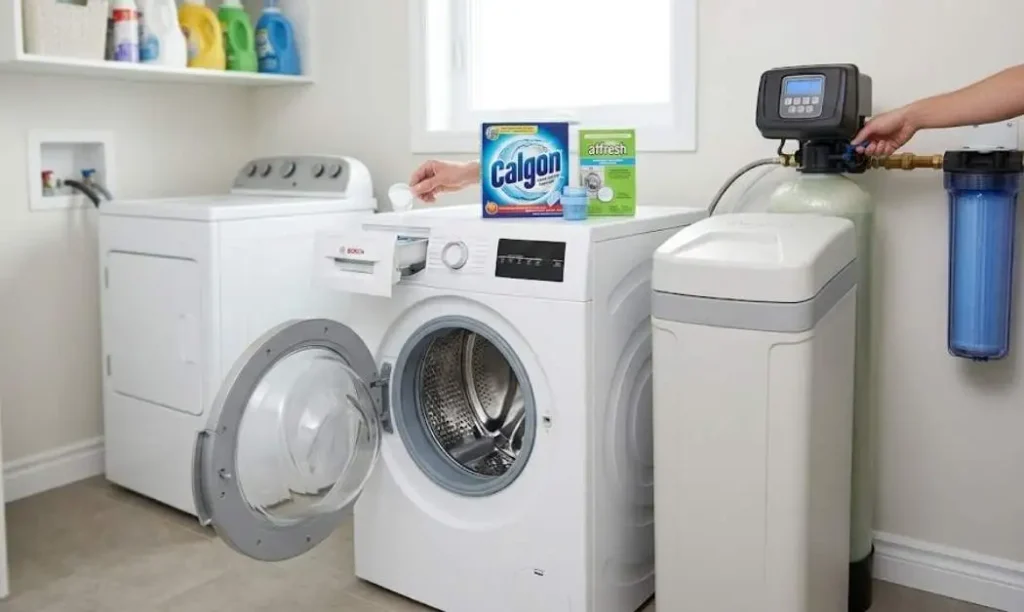
The good news is that hard water damage is preventable with consistent maintenance. The following steps are specifically relevant for Durham Region homeowners.
Running a monthly drum cleaning cycle using a commercial washing machine cleaner or a combination of white vinegar and baking soda removes early scale deposits before they harden. Pour two cups of white distilled vinegar directly into the drum and run a hot empty cycle. This is the simplest and most cost-effective descaling step for any homeowner.
Washing machine descaling tablets, available at most hardware and home improvement stores in the Oshawa and Whitby area, are formulated to dissolve calcium carbonate scale more aggressively than vinegar alone. Used quarterly, they can significantly extend drum life in hard water conditions.
Adjusting your wash temperatures also helps. While hot water loosens grease and kills bacteria, it also accelerates mineral crystallization. Washing most loads at 30 or 40 degrees Celsius rather than 60 degrees reduces the rate at which scale forms without meaningfully compromising cleaning results for everyday laundry.
Using a hard water specific laundry detergent, or adding a water softening additive to each wash, reduces the chemical reaction between minerals and surfactants. Several products are designed specifically for high-mineral water conditions and can dramatically reduce the amount of residue left inside the drum.
For homeowners dealing with severe hard water problems, a whole-home water softener installed at the point of entry is the most permanent solution. Ion exchange water softeners remove calcium and magnesium from the water supply before it reaches any appliance, not just the washing machine. While the upfront cost is significant, the long-term savings in appliance repair and replacement across all water-using appliances in the home are generally substantial.
When to Call a Washing Machine Repair Technician in Durham Region
Some hard water damage can be addressed with DIY maintenance, but other situations require a trained appliance repair technician. If your machine is producing grinding or rumbling noises during the spin cycle, that is a bearing issue that requires professional assessment. Leaking from the door seal, persistent error codes related to water intake or drainage, or a drum that vibrates excessively during use are all situations where a qualified technician should inspect the machine before the damage becomes total loss.
A professional can also assess whether hard water scale has compromised the drum itself structurally, or whether the drum’s metal surface has developed active corrosion. In some cases, early intervention by a repair technician costs far less than waiting until major components fail completely.
👉🏻Discover More About Unique Appliance Problems[ Why Oshawa’s Lake Ontario Wind Makes Your Fridge Work Harder in Winter ]
Frequently Asked Questions
How hard is the water in Oshawa and the Durham Region?
Durham Region’s municipal water, drawn from Lake Ontario and treated at the Oshawa Drinking Water System facility, falls in the moderately hard to hard range. The dissolved mineral content varies seasonally and by neighbourhood depending on the age and condition of distribution infrastructure, but homeowners in the area consistently report scale-related issues on appliances over time.
Can hard water actually break a washing machine drum?
Yes, over a period of several years, hard water mineral buildup can structurally compromise a washing machine drum. Scale deposits accelerate corrosion of the drum’s metal surface and the drum support bearing, which can ultimately lead to drum failure requiring full replacement or machine disposal.
How often should I descale my washing machine in Durham Region?
For Durham Region homeowners, a monthly hot cycle with a descaling agent, whether white vinegar, a commercial tablet, or a dedicated washing machine cleaner, is a sensible routine. A deeper descale treatment every three months using a purpose-made product provides additional protection.
Does using cold water protect my washing machine from hard water damage?
Washing at lower temperatures does slow the rate of scale formation because minerals crystallize more readily when water is heated. However, cold water does not prevent mineral deposits entirely. It simply slows the accumulation, which is still beneficial. Descaling treatments are still necessary even for households that wash predominantly in cold water.
Will a water softener completely prevent hard water damage to my washing machine?
A whole-home ion exchange water softener is the most effective preventive measure available. By removing calcium and magnesium at the point of entry, it eliminates the root cause of limescale formation throughout the entire home’s plumbing and all water-using appliances.
What does hard water scale look like inside a washing machine drum?
Scale inside a drum typically appears as a white, grey, or faintly yellowish chalky deposit. It may be most visible around the drum’s perforations, along the rear wall, and on the rubber door gasket of front-load machines. In advanced cases it can feel gritty or rough to the touch.
Is it worth repairing a washing machine with severe hard water damage in Durham Region?
This depends on the age of the machine and the specific components affected. Minor scale buildup on a relatively new machine is worth addressing through professional cleaning and maintenance. However, if the drum bearing has failed, the drum itself is corroded, or multiple components are compromised simultaneously, replacement may be more economical. A local appliance repair technician can provide an honest assessment.
Conclusion
Hard water is a quiet but persistent threat to every washing machine operating in Durham Region, Ontario. From the first mineral film that settles on your drum in year one, to the scale-encrusted door gasket and failing drum bearing of year four or five, the damage follows a predictable path that the region’s calcium-rich water supply makes almost inevitable for homeowners who do not take preventive steps.
The encouraging reality is that this damage is largely manageable with the right habits. Monthly descaling, smarter wash temperature choices, hard water compatible detergents, and a thorough understanding of the warning signs can add years of productive life to your appliance. For those dealing with advanced scale problems or mechanical symptoms, reaching out to a local Durham Region appliance repair professional early is always the smarter and more cost-effective path compared to waiting for a full breakdown.