
Oshawa Lake Wind plays a major role in winter conditions as Oshawa sits directly in the path of cold northwesterly winds that travel across Lake Ontario during the colder months. These winds lower the ambient temperature inside poorly insulated kitchens, garages, and utility spaces. When the air around your refrigerator drops below the appliance’s designed operating range typically between 10°C and 32°C the compressor begins to cycle erratically, the thermostat gets confused, and the unit either overworks itself trying to maintain safe food temperatures or shuts off entirely. Either way, your fridge is under stress it was never designed to handle, and both your energy bill and potential repair costs can increase significantly.
What to Expect When Appliances Break Down in Oshawa Houses
If you are dealing with What to Expect When Appliances Break Down in Oshawa Houses, it is important to understand that appliance failures can happen unexpectedly due to regular wear and tear, power issues, or lack of maintenance. In Oshawa homes, common problems include fridge cooling failure, washing machine drainage issues, and oven heating faults, which can quickly disrupt daily routines. When this happens, it’s best to look for fast and reliable repair solutions, proper troubleshooting, and preventive maintenance to avoid costly replacements. For more detailed guidance and quick help, you can explore our What to Expect When Appliances Break Down in Oshawa Houses internal resource to understand common issues and expert repair solutions.
Living in Oshawa Means Living With Lake Ontario’s Winter Personality
If you have lived in Oshawa for even one full winter, you already know that the cold here is not the same as cold in, say, Barrie or London. Durham Region sits right along the northern shore of Lake Ontario, and that geography shapes everything about how winter feels in your neighbourhood. The lake acts like a long open runway for cold Arctic air. When northwest winds pick up speed and travel across that open water before hitting the Oshawa shoreline, they arrive carrying extra moisture and biting intensity.
These are not just occasional gusts. Environment Canada regularly reports wind chill values in Oshawa dipping into the minus twenties and beyond through January and February. During severe polar vortex events, residents in central Oshawa have felt wind chills approaching minus thirty-five Celsius. That is the kind of cold that does not just stay outside. It works its way through wall gaps, basement windows, attached garages, and poorly sealed utility rooms.
Now think about where your refrigerator lives. If it sits in an open-concept kitchen near an exterior wall, a drafty back mudroom, or an unheated garage, that cold air is affecting your appliance far more than you probably realize.
How Lake Ontario’s Wind Chill Affects Refrigerator Performance
A refrigerator is an interesting machine when you think about it. It is designed to create cold air on the inside while expelling heat on the outside. The whole system works beautifully within a specific ambient temperature range. Most standard residential refrigerators are engineered to function optimally in environments between 10°C and 32°C. Below or above that window, the appliance starts to struggle.
In Oshawa’s winters, the problem is usually the cold side of that equation.
When the room or garage where your fridge sits gets too cold, a few things start to go wrong at the same time.
The Thermostat Gets Fooled
The thermostat inside most standard refrigerators is located in the fresh food compartment. It monitors the air temperature in that section and tells the compressor when to run. Here is the problem: if the ambient air outside your fridge is already as cold as, or colder than, the temperature you have set inside, the thermostat thinks the job is done. It stops calling for the compressor to run.
That sounds harmless until you remember that the freezer compartment depends entirely on that same compressor cycling to stay frozen. If the compressor sits idle because the thermostat is satisfied by the surrounding cold air, the freezer warms up from within. Food that was solidly frozen starts to soften. And because it happens gradually, many Oshawa homeowners do not notice until they pull out a bag of meat that has partially thawed and refrozen.
The Compressor Oil Thickens in Extreme Cold
The compressor relies on lubricating oil to keep its moving parts running smoothly. In extreme cold, that oil becomes thick and viscous, similar to what happens to motor oil in a car engine during a harsh Ontario winter. A compressor fighting through thick lubricant has to work harder to start each cycle. Over time, that added mechanical stress leads to premature wear. In the worst cases, it causes compressor failure outright.
This is particularly relevant in Oshawa homes where the fridge lives in an attached garage or a utility room on the back of the house, exposed to the wind coming off the lake.
Door Seals Fail Faster in Fluctuating Temperatures
Oshawa winters are not just cold. They involve sharp temperature swings, especially in late autumn and early spring. Lake Ontario moderates extreme lows but also creates sudden warm spells followed by rapid refreezing. These fluctuations cause the rubber gaskets around your refrigerator door to expand and contract repeatedly. Over time, those seals lose their flexibility and start to gap. Even a small gap in the door seal allows warm interior air to escape and cold drafty air to enter, forcing the fridge to run longer and harder to compensate.
Why Your Kitchen Location in Oshawa Matters More Than You Think
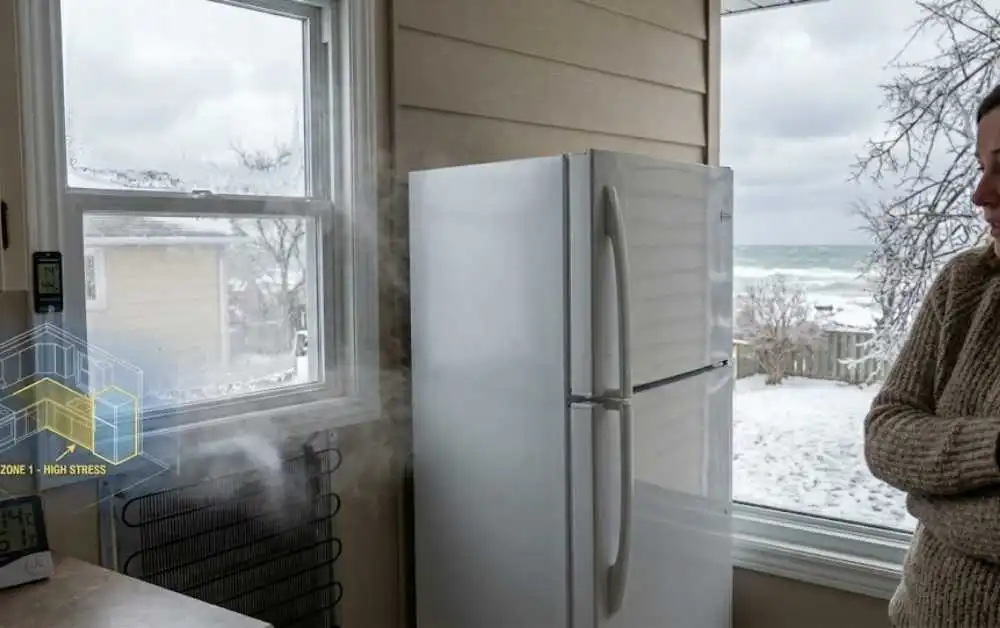
Oshawa’s residential neighbourhoods each have slightly different wind exposure patterns. Homes in Lakeview and south Oshawa, situated close to the waterfront, experience the most direct exposure to lake winds. Properties in older neighbourhoods like McLaughlin and O’Neill often have larger lots with fewer windbreaks, meaning wind can wrap around the house and find entry points in older construction. Newer builds in Windfields and Kedron tend to have better insulation standards, but even modern homes are not immune to cold infiltration around garage doors and basement utility areas.
If your fridge is positioned near an exterior wall on the north or west side of your home, directly in the path of the prevailing winter winds, the internal temperature of your kitchen can drop noticeably on the coldest nights. That drop is enough to push the ambient air around your appliance below the optimal operating threshold.
The Lake Effect Snow Factor
Beyond wind, Oshawa also sits within a zone that receives lake effect snow events. When cold dry air passes over the relatively warmer open water of Lake Ontario, it picks up moisture and dumps heavy localized snowfall on communities along the northern shore, including Oshawa, Whitby, and Pickering. These events are often accompanied by sustained cold winds that last for days at a time.
During these extended cold periods, the temperature in attached garages and poorly insulated utility spaces can stay consistently below the critical 10°C threshold for days. That is long enough to cause cumulative stress on your refrigerator’s compressor, thermostat, and door seals simultaneously.
Signs Your Fridge Is Struggling Because of Oshawa’s Winter Cold
You do not always need a technician to tell you something is wrong. There are a handful of warning signs that point specifically to cold ambient temperature stress on your refrigerator.
Food in the freezer compartment is thawing or becoming soft, even though the unit is plugged in and appears to be running normally. This is the most common symptom of thermostat confusion caused by cold surroundings.
You notice frost building up heavily on the interior walls of the refrigerator compartment. This often happens when outside cold air is getting in through a failing door gasket or when the defrost cycle is not running properly due to irregular compressor cycling.
Your electricity bill goes up in January and February even though you have not changed your household habits. This happens when a fridge in a cold space gets confused and cycles on and off erratically, drawing power in short frequent bursts rather than efficient long cycles.
You hear the compressor running almost constantly, or alternatively, you notice unusual silence from a fridge that used to hum steadily. Both extremes signal a thermostat or compressor issue that is often linked to operating outside the recommended temperature range.
There is ice forming on or around the water line connection on the back of the fridge. Oshawa winters are cold enough to freeze exposed water supply lines in garages and utility rooms, which creates pressure issues and potential pipe damage.
What Oshawa Homeowners Can Do About It
The good news is that most of these problems are manageable with some practical steps before winter arrives.
Keep your garage or utility room above 10°C. If your fridge lives in an unheated garage, consider adding a small space heater on a thermostat to maintain a minimum ambient temperature through the coldest months. This simple step keeps the compressor oil fluid, the thermostat cycling properly, and the door seals intact.
Seal the drafts around your garage door and exterior walls. Oshawa homes, particularly those built before the 1990s, commonly have gaps around garage door frames where cold wind penetrates easily. Adding weatherstripping and foam backer rod to those gaps is inexpensive and makes a meaningful difference in maintaining a stable temperature around your appliance.
Check your door gaskets every autumn. Run a piece of paper between the door and the body of the fridge and pull it out. If it slides out easily without resistance, your gasket is no longer sealing properly. A deteriorating gasket in Oshawa’s climate is a significant energy drain all winter long. Replacement is a straightforward repair that a local appliance technician can handle quickly.
Consider a garage-ready refrigerator if you need a second fridge. If you run a second unit in an unheated or partly heated garage, standard residential refrigerators are not the right tool for the job. Garage-ready or outdoor-rated models have thermostats and compressors designed to function in wider temperature ranges, including below the standard 10°C minimum.
Clean your condenser coils before winter. Dirty condenser coils force the compressor to work harder to expel heat, which compounds the stress that cold ambient temperatures are already creating. Cleaning them in October takes about twenty minutes and meaningfully extends the life of the compressor.
Position your fridge away from exterior walls when possible. Even moving a refrigerator a metre or two away from a north-facing or west-facing wall can reduce the cold air exposure it experiences on windy Oshawa winter nights.
When to Call a Refrigerator Repair Technician in Oshawa
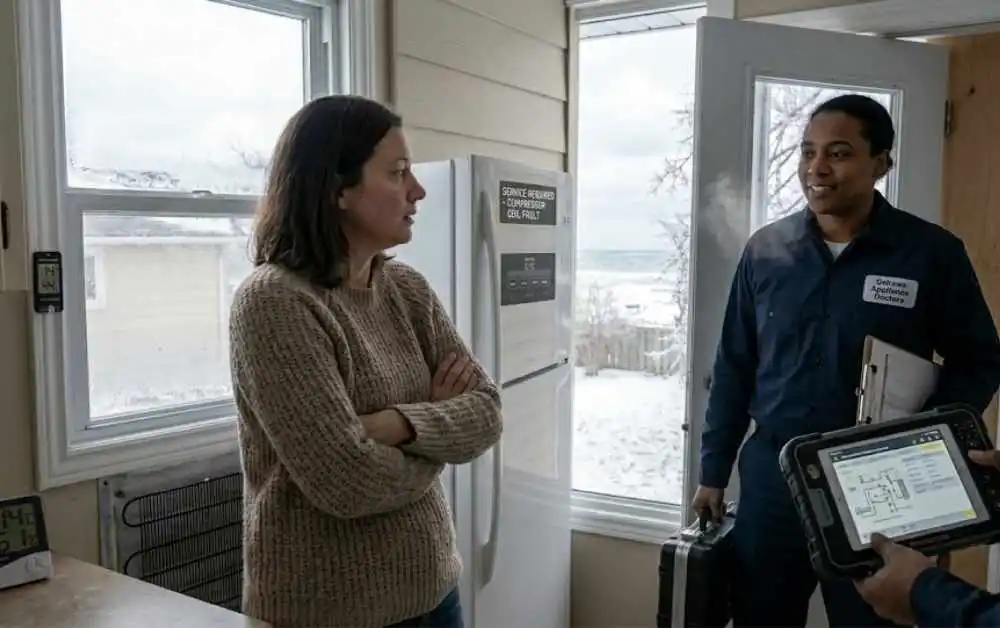
Some of the damage that Oshawa’s winter climate does to refrigerators is mechanical and cannot be reversed with DIY adjustments. If you have tried to address the ambient temperature issues and your fridge is still not cooling properly, your freezer contents keep softening, or your compressor is making grinding or clicking sounds, it is time to call a local appliance repair professional.
Winter in Oshawa is not the time to leave a faulty refrigerator unattended. A compressor that fails completely is a significantly more expensive repair than addressing the early warning signs. Food spoilage on top of a major repair bill is a situation worth avoiding with a timely service call.
A qualified technician can test your thermostat calibration, check refrigerant levels, assess compressor health, and inspect your door gaskets all in a single visit. In most cases, catching the problem at the first symptom keeps repair costs well within reason.
👉🏻Discover More About Unique Appliance Problems[ Refrigerator Ice Maker Not Working ]
Frequently Asked Questions About Oshawa’s Winter Wind and Refrigerator Performance
Why does my freezer stop working properly in Oshawa winters even though my fridge seems fine?
This is one of the most common complaints local technicians hear during January and February. The thermostat in most standard refrigerators sits in the fresh food compartment, not the freezer. When the ambient temperature outside the appliance is very cold, the thermostat senses the cold air and stops calling for the compressor to run. The freezer, which has no independent thermostat in most models, depends on those compressor cycles to stay frozen. When the compressor stops cycling, the freezer gradually warms up from within.
Is it safe to keep my refrigerator in an unheated Oshawa garage through winter?
It depends on how cold the garage gets. Most standard residential refrigerators should not be operated in spaces that regularly fall below 10°C. Oshawa garages, particularly those attached to older homes with minimal insulation and significant wind exposure from the lake, can drop well below that threshold during cold snaps. If you want to use a second fridge in your garage through winter, either maintain the space above 10°C with supplemental heat or invest in a model specifically rated for low ambient temperatures.
Does the cold wind off Lake Ontario actually get inside my house and affect my fridge?
Yes, it can, especially in older Oshawa homes. Cold air infiltration through gaps around windows, doors, and utility penetrations is common in houses built before modern energy codes were introduced. If your fridge is positioned near an exterior wall, a drafty mudroom, or on the ground floor close to the garage, the ambient air around it can drop several degrees below the rest of your home during peak cold events.
How often should I have my refrigerator serviced in a climate like Oshawa’s?
A full appliance check every one to two years is reasonable for Oshawa homeowners, with particular attention to condenser coil cleaning in the autumn, door gasket inspection before winter, and a compressor health check if the unit is more than seven years old. Seasonal maintenance is genuinely protective in a climate where winter puts extra stress on these systems.
Why is my electricity bill higher in winter even though my fridge should not have to work as hard?
This seems counterintuitive, but it is actually a well-documented pattern. When ambient temperatures fall too low, refrigerators do not simply coast. They cycle erratically, overcompensate when the compressor does run, and often run longer individual cycles trying to maintain stable internal temperatures against a confused thermostat. The result is more total energy consumption, not less.
Can dirty condenser coils make winter cold-weather problems worse?
Absolutely. Dirty condenser coils restrict the ability of the refrigerator to release heat efficiently. In winter, a fridge is already working against unusual operating conditions. Adding clogged coils on top of that means the compressor runs hotter, longer, and harder than it should. Coil cleaning in October is one of the best preventive steps an Oshawa homeowner can take before the cold season arrives.
What is the ideal placement for a refrigerator in an Oshawa home to minimize winter problems?
The best position is inside a climate-controlled space, away from exterior walls, away from direct drafts from doors and windows, and not in an unheated attached garage. A kitchen or finished utility room that stays between 10°C and 24°C year-round is the ideal operating environment. If your current layout puts the fridge near a cold exterior wall, improving the insulation and sealing in that area of your home will reduce both the strain on the appliance and your overall heating costs.
Conclusion
Oshawa’s relationship with Lake Ontario is one of the defining features of life in this part of Durham Region. The lake brings stunning summer waterfront days, but it also brings serious winter wind that most homeowners underestimate when it comes to how their appliances perform. Understanding that your refrigerator has a real operating temperature range, and that Oshawa winters routinely push against the lower end of that range, is the first step toward preventing expensive breakdowns and unnecessary energy waste.
The connection between lake-driven wind chill and refrigerator stress is not a theory. It is a practical reality that plays out in thousands of Oshawa kitchens and garages every winter season. Addressing it through better insulation, seasonal maintenance, and smart appliance placement puts you ahead of the problem before it costs you.
If your refrigerator is already showing signs of struggle this winter, do not wait for a complete failure before acting. A local Oshawa appliance repair technician can assess the situation quickly and recommend repairs that are proportional to the actual problem. Catching a thermostat issue or a failing gasket early is almost always cheaper than replacing a compressor or dealing with spoiled food after a full breakdown during a cold snap.